Renogy 100W Portable Solar Panel
100 W. Review the available facts and what still needs checking before deciding whether it fits.
Not confirmed: Bifacial · Voc (V).
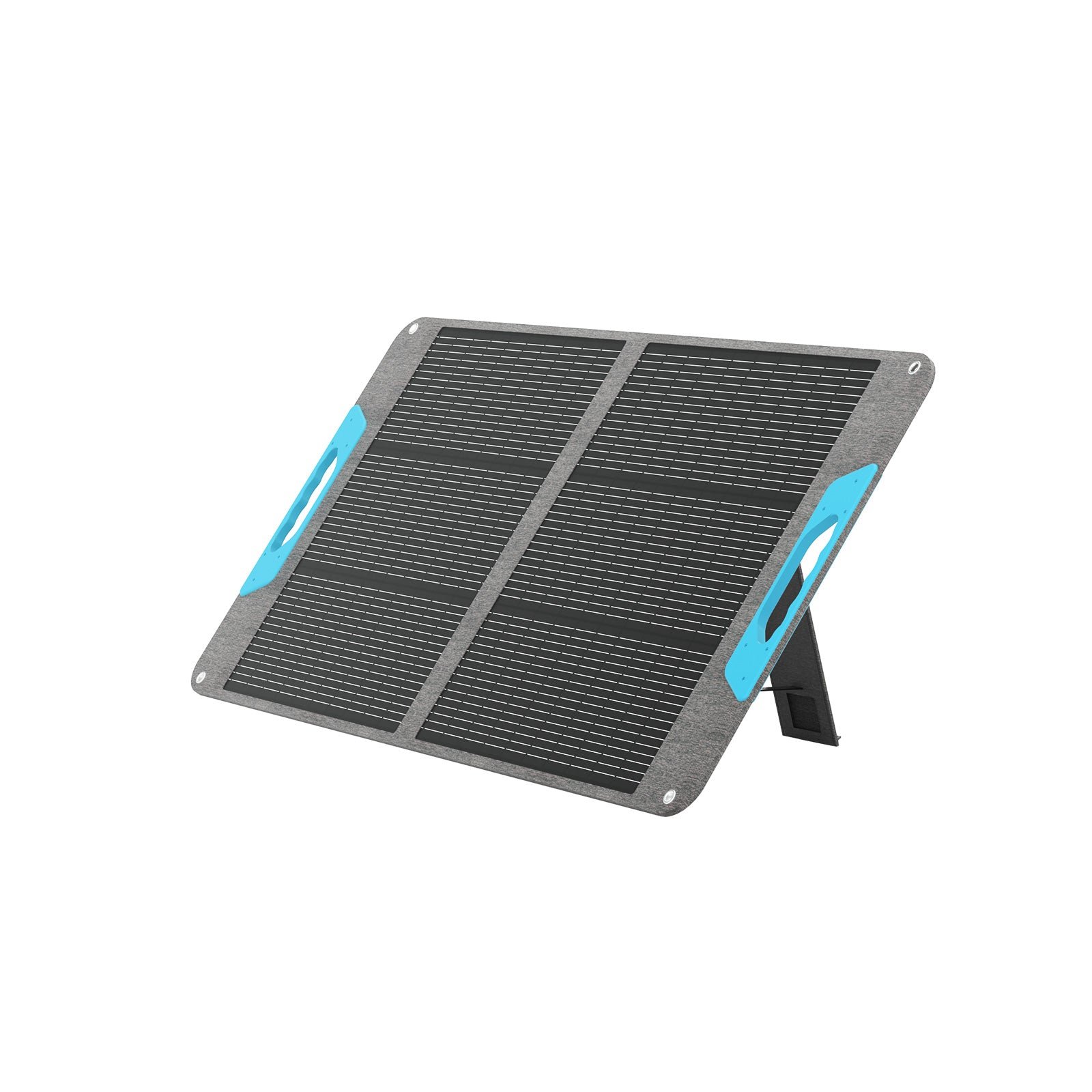
Review, specifications and verdict
Editorial analysis based on published specifications; we have not physically tested this product.
The Renogy 100W Portable Solar Panel is a folding 100 W panel with 25% efficiency, IP67 sealing, USB ports and a 3-year warranty, at 4.0 kg. On paper, it is a well-rounded, weather-ready panel for small stations and trickle charging. We have not used it ourselves: the data comes from the official Amazon listing, checked on September 26, 2026, and the math is ours.
The Renogy 100W covers the basics well. Its 25% efficiency matches the best 100 W panels in our US catalog, and IP67 means rain and dust are not a worry. USB ports let you top up a phone straight from the sun, and the 3-year warranty is the longest among our 100 W panels. The trade-offs are weight and connector. At 4.0 kg, it is heavier than the HQST and FlexSolar 100 W panels. It outputs through MC4 cables only, so most portable stations need an adapter. The listing also does not publish an open-circuit voltage.
Pros
- 25% efficiency, level with the best 100 W panels we track
- IP67 water and dust rating
- USB outputs and a 3-year warranty
Cons
- MC4 output only; you need an adapter for most stations
- 4.0 kg, heavier than the HQST (2.7 kg) and FlexSolar (1.9 kg)
- Best for
- Weather-exposed camping and RV use with small and mid-size stations
- Skip it if
- Backpackers, or buyers who want a plug-and-play connector
Specifications
| Power (W) | 100 |
|---|---|
| Efficiency (%) | 25 |
| Weight (kg) | 4 |
| IP rating | IP67 |
| Connector | MC4 |
| USB output | Yes |
| Warranty (years) | 3 |
| Power (W) | 100 |
|---|---|
| Efficiency (%) | 25 |
| Weight (kg) | 4 |
| IP rating | IP67 |
| Connector | MC4 |
| USB output | Yes |
| Warranty (years) | 3 |
How much power will you really get?
Plan on about 75 W in good sun. Portable panels typically deliver 70–80% of their rating because of heat, angle and haze. We use 0.75: 100 × 0.75 = 75 W.
| Conditions | Peak sun hours | Math | Daily energy |
|---|---|---|---|
| Sunny summer day, Southwest | 6 | 75 × 6 | 450 Wh |
| Typical summer day, most of the US | 5 | 75 × 5 | 375 Wh |
| Spring or fall day | 4 | 75 × 4 | 300 Wh |
| Northern winter day | 2.5 | 75 × 2.5 | about 190 Wh |
These sun-hour values are approximate. Our guide on how many solar watts you need breaks them down by US region.
What can one 100 W panel keep charged?
Small stations and daily top-ups, not a large battery from empty. The formula is capacity ÷ (panel watts × 0.75).
- Anker SOLIX C300X DC (288 Wh): 288 ÷ 75 = 3.8 peak sun hours, less than one summer day.
- Grecell H1200 (672 Wh): 672 ÷ 75 = 9 peak sun hours, about two days.
- EcoFlow DELTA 3 (1,024 Wh): 1,024 ÷ 75 = 13.7 peak sun hours, about three days.
On a typical 375 Wh day, one panel roughly covers a 12V compressor cooler averaging about 15 W around the clock (375 ÷ 24 = 15.6 W), before station losses. For larger stations, add a second panel or step up to 200 W.
Will it plug into your station?
Only with an adapter, because the listing states MC4 output cables only. MC4 is the standard for RV roof systems and charge controllers, so it wires straight into those.
Portable stations use XT60, Anderson, DC7909 or DC8020 inputs. Check your station’s manual, then buy the matching MC4 adapter. A wrong or loose adapter is the first thing to check if a power station does not charge from solar.
The listing does not publish the panel’s Voc. Read it from the label before wiring two panels in series.
How weatherproof is it?
IP67 means dust-tight and protected against temporary immersion. A rain shower at camp is not a problem for the panel surface.
Connectors and cable ends are still the weak spots. Keep them off wet ground and out of puddles. The 3-year warranty covers output, materials and workmanship.
How do you get the most out of a 100 W panel?
Aim it, keep it cool and keep every cell in the light. With only 100 W to work with, small losses add up fast.
- Angle: face the sun at roughly 90 degrees and re-aim every two or three hours.
- Shade: even a strap or branch across one section can cut output sharply.
- Heat: leave air space behind the panel; hot cells produce less.
- Cables: use the shortest extension that reaches, sized for the current.
If output stays far below 75 W in full sun, work through our low solar output checklist.
How portable is it?
At 4.0 kg (8.8 lb), it is easy to carry but not ultralight. It works out to 25 W per kg.
The HQST 100W weighs 2.7 kg and the FlexSolar 100W just 1.9 kg. If you hike or bike with your panel, those save real weight. For car camping and RVs, the difference matters less. See our best solar panels for camping.
8.5/10 · WilderWatt scoreHow does it compare with the HQST 100W and FlexSolar 100W?
The Renogy has the longest warranty and USB ports; the others are much lighter.
| Model | Power (W) | Efficiency (%) | Weight (kg) | IP rating | Connector | Warranty (years) | WilderWatt score | |
|---|---|---|---|---|---|---|---|---|
| 100 | 25 | 4 | IP67 | MC4 | 3 | 8.5 | ||
| 100 | 25 | 2.7 | IP67 | XT60, DC7909, DC5521 | — | 8.5 | ||
| 100 | 23 | 1.9 | IP67 | DC5521, DC7909, Anderson, XT60 | — | 9 |
(affiliate link) · Data from the Amazon listing; offers may change.
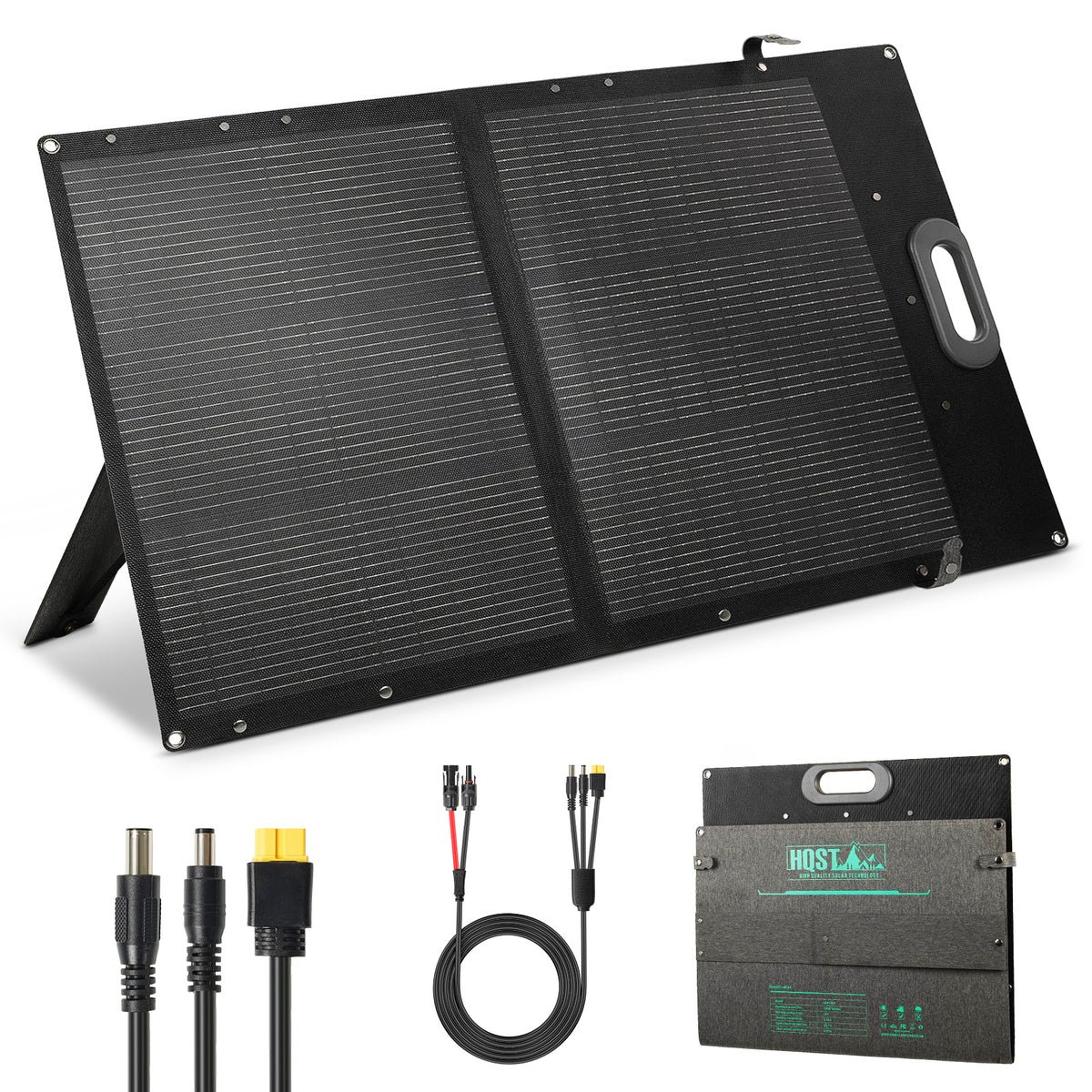
- HQST 100W N-Type: 25% efficiency, IP67, 2.7 kg and an adapter cable with XT60, DC7909 and DC5521 ends. The catch is that the listing does not state a warranty term. Full comparison in Renogy 100W vs HQST 100W.
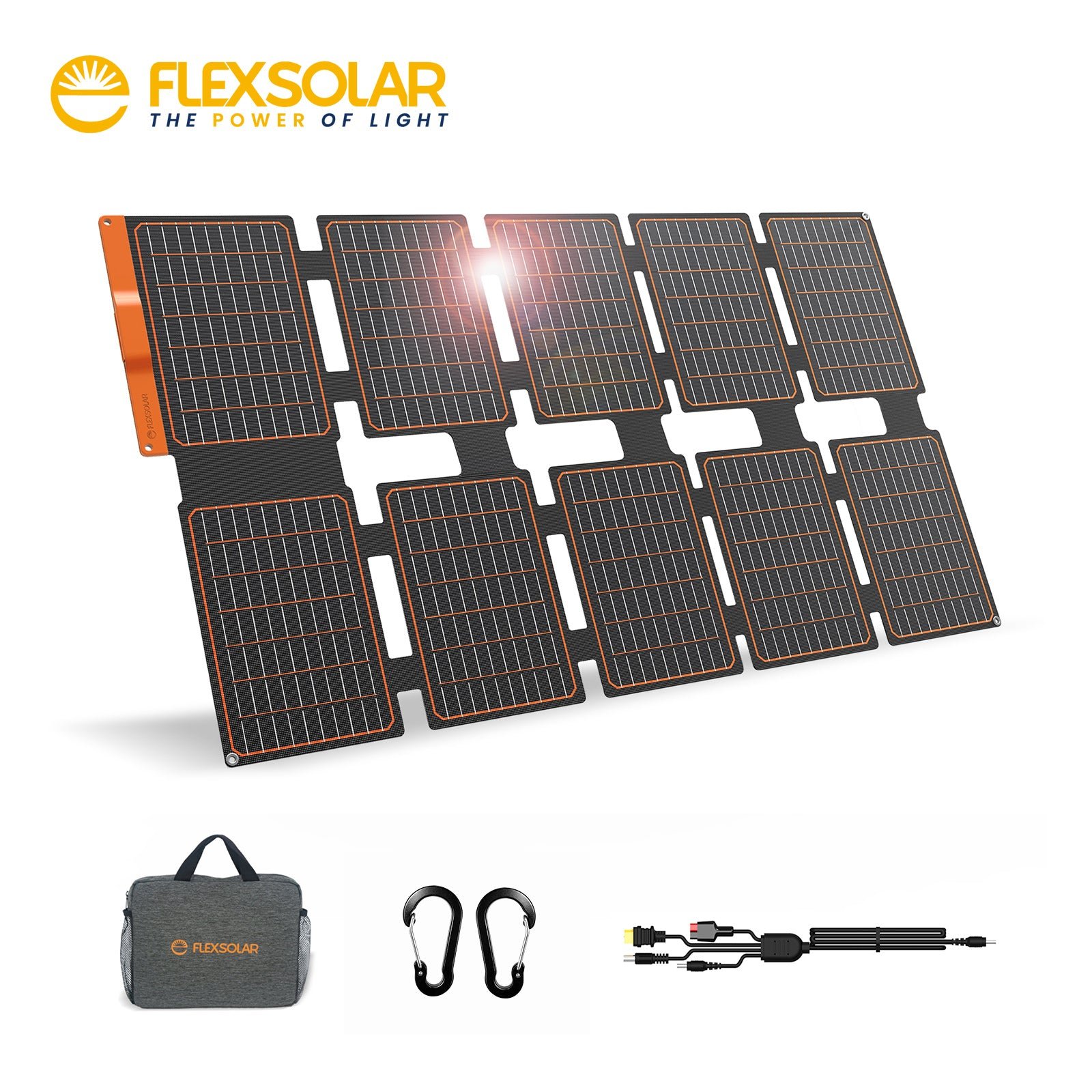
- FlexSolar 100W: 23% efficiency, IP67, 1.9 kg, USB outputs and a cable with DC5521, DC7909, Anderson and XT60 ends. The catch is slightly lower efficiency and no stated warranty term.
Who should buy the Renogy 100W?
It suits buyers who value weather sealing and warranty over the last kilogram.
Buy it if you:
- Camp or travel in wet weather.
- Use MC4 wiring in an RV or with a charge controller.
- Want USB charging straight from the panel.
Skip it if you:
- Carry the panel on foot; the FlexSolar is half the weight.
- Want a panel that plugs into your station with no extra parts.
For more choices, see the best portable solar panels.
Frequently asked questions
How much power does the Renogy 100W portable panel really produce?
About 75 W in good sun, since portable panels typically deliver 70–80% of their rating. Over 5 peak sun hours, that is about 375 Wh.
Is the Renogy 100W panel waterproof?
Renogy lists IP67, which means dust-tight and protected against temporary immersion. Keep the connectors dry anyway.
What connector does the Renogy 100W panel use?
The listing states it has MC4 output cables only. You need an MC4 adapter that matches your power station’s solar input.
Can the Renogy 100W charge a phone directly?
Yes. The listing states the panel has USB-C PD and USB-A outputs.
How long does it take to charge a 1 kWh power station?
About 13.7 peak sun hours for 1,024 Wh: 1,024 ÷ (100 × 0.75). That is around three summer days, so pair two panels or use it with smaller stations.
What warranty does the Renogy 100W panel have?
Renogy lists a 3-year output, material and workmanship warranty.