The 6 Best Small Wind Turbines of 2026 (With Realistic Output)
- Data from official spec sheets
- Public scoring formula
- No paid placements
The Pikasola 400W 12V 3-Blade is the best small wind turbine for most 12 V systems: MPPT controller, 2.5 m/s start-up and a 1-year warranty declared. For 24 V banks, pick its 24 V twin. Expect far less than 400 W: about 350-700 Wh a day in steady 4-5 m/s wind.
On this page (10)
- How do the 6 turbines compare?
- How much will they really produce?
- Which one fits your situation?
- The 6 best small wind turbines, reviewed
- How do I choose a small wind turbine?
- Where should I mount a small wind turbine?
- Should I buy a turbine or more solar panels?
- What are the most common mistakes?
- How do they rank by use?
- What is our verdict?
The Pikasola 400W 12V 3-Blade is the best small wind turbine for most 12 V battery systems. Its listing declares an MPPT controller, a 2.5 m/s start-up speed and a 1-year warranty, which is more than most turbines in our catalog publish. For 24 V banks, the Pikasola 400W 24V 3-Blade is the same design with the most complete listing of the six. The VEVOR 800W has the highest rating if you have space for it.
Before you pick one, reset your expectations. The watts in the title are reached only in strong wind. At the 4-5 m/s averages common in yards and campsites, a 400 W turbine delivers tens of watts, not hundreds. We have not tested these turbines; the rankings use listing specs and physics, and both brands are lesser-known names with thin documentation.
Pikasola 400W 12V 3-Blade Wind Turbine
400 W · 12 V
MPPT controller included, 2.5 m/s start-up and a 1-year warranty declared.
The catch: The listing does not publish its weight.
Pikasola 400W 24V 3-Blade Wind Turbine
400 W · 24 V
Same MPPT 3-blade design for 24 V banks, with weight (8.4 kg) and warranty published.
The catch: Only for 24 V battery banks.
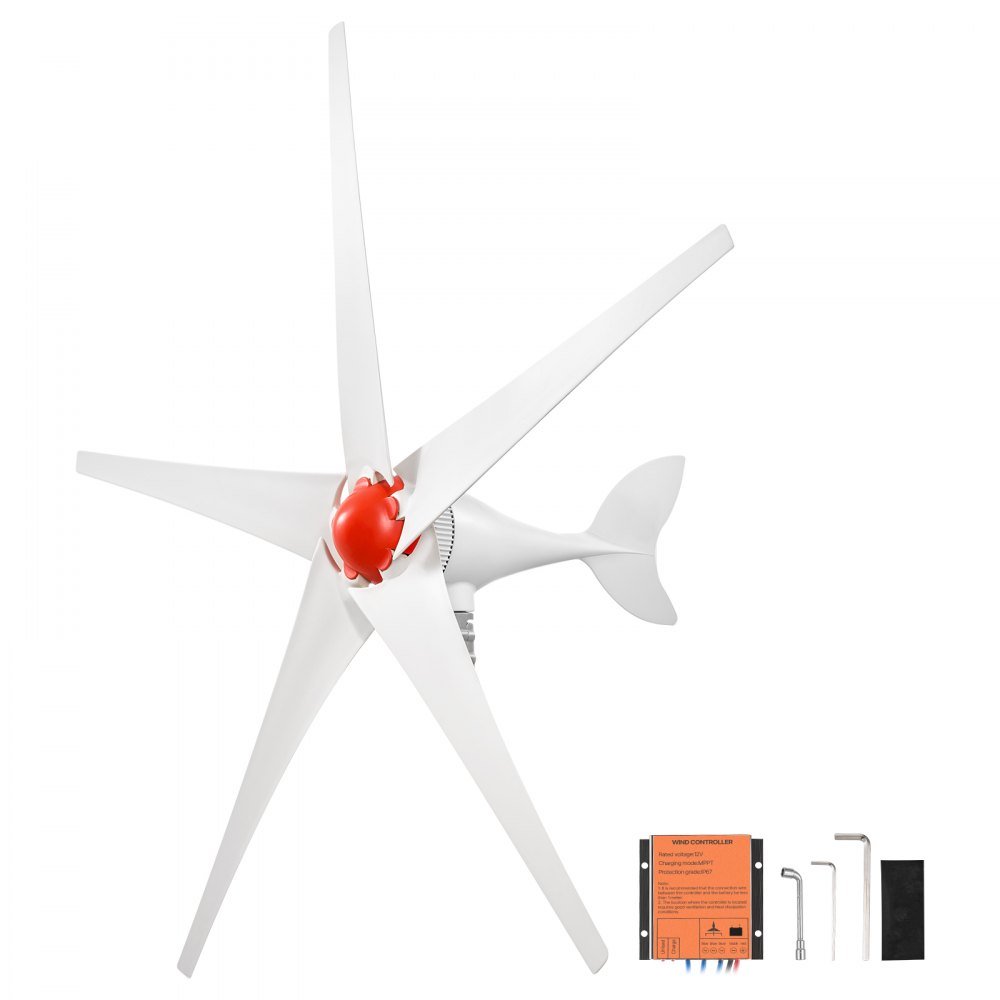
VEVOR 800W 12V Wind Turbine
800 W · 12 V
800 W rating, 5 blades and an MPPT controller at 8.5 kg (18.7 lb).
The catch: No warranty period and no rated wind speed on the listing.
How do the 6 turbines compare?
Four are 400 W, one is 800 W and one is a 200 W vertical-axis model; all include a controller. Empty cells mean the listing does not publish that figure. None of the six publishes a rated wind speed or rotor diameter, the two numbers that best predict real output.
| Model | Rated power (W) | Voltage (V) | Blades | Start-up wind (m/s) | MPPT | Weight (kg) | Warranty (years) | WilderWatt score | Best for | |
|---|---|---|---|---|---|---|---|---|---|---|
| 400 | 12 | 3 | 2.5 | Yes | — | 1 | 7.5 | 12 V systems | ||
| 400 | 24 | 3 | 2.5 | Yes | 8.4 | 1 | 7.5 | 24 V systems | ||
| 800 | 12 | 5 | 2.5 | Yes | 8.5 | — | 7 | Highest rating | ||
| 400 | 12 | 5 | 2.5 | — | 6.2 | — | 6 | Lightest | ||
| 400 | 12 | — | — | — | 8.3 | 1 | 6 | Wind plus solar | ||
| 200 | 12 | 5 | — | — | 11.3 | — | 5.5 | Vertical axis |
(affiliate link) · Data from the Amazon listing; offers may change.
How much will they really produce?
In steady 4-5 m/s wind, a 400 W turbine makes roughly 350-700 Wh a day; an 800 W one roughly twice that. Power in the wind rises with the cube of its speed. Small-turbine ratings are typically quoted at around 11-13 m/s, so we assume 12 m/s for all six:
| Rating | Steady 4 m/s (8.9 mph) | Steady 5 m/s (11.2 mph) | Steady 6 m/s (13.4 mph) |
|---|---|---|---|
| 200 W | ≈ 7 W, 178 Wh/day | ≈ 14 W, 347 Wh/day | ≈ 25 W, 600 Wh/day |
| 400 W | ≈ 15 W, 356 Wh/day | ≈ 29 W, 694 Wh/day | ≈ 50 W, 1,200 Wh/day |
| 800 W | ≈ 30 W, 711 Wh/day | ≈ 58 W, 1,389 Wh/day | ≈ 100 W, 2,400 Wh/day |
Each cell is rated W × (speed ÷ 12)³, then × 24 hours. Real wind is never steady, and a turbine produces nothing below its start-up speed, so treat these as rough orders of magnitude. Enter your own average wind below.
Estimated average output: 0 W · 0 Wh/day · 0 kWh/year
Formula: average power ≈ rated power × (average wind ÷ rated wind)³ × 1.9, capped at rated power. The 1.9 factor accounts for wind variability (Rayleigh distribution). It is an optimistic estimate: obstacles, mast height and turbulence reduce it.
For context, 356 Wh a day is about 28 percent of a 12V 100Ah LiFePO4 battery (356 ÷ 1,280). That is useful winter top-up energy, not a primary power source. Our guide are small wind turbines worth it? goes deeper.
Which one fits your situation?
Match the voltage to your battery bank first, then choose by features.
Pick by what you need
The 6 best small wind turbines, reviewed
This Pikasola earns the top spot because its listing covers the features that matter most for a small turbine. It declares an MPPT controller, which tracks the best operating point as wind speed changes, plus a 2.5 m/s start-up speed and a 1-year warranty. Pikasola is a lesser-known brand, so a stated warranty counts.
At 12 V it plugs into the most common RV, marine and small off-grid banks. The gaps are weight, rated wind speed and rotor diameter, none of which the listing publishes. Check the mast load with the seller before you order.
Pros
- MPPT controller included
- 2.5 m/s start-up speed declared
- 1-year warranty stated on the listing
Cons
- Weight is not published
- No rated wind speed or rotor diameter
- Best for
- 12 V battery banks in cabins, boats and RVs on windy sites
- Skip it if
- Sheltered yards or rooftop mounting
Specifications
| Rated power (W) | 400 |
|---|---|
| Voltage (V) | 12 |
| Blades | 3 |
| Start-up wind (m/s) | 2.5 |
| Controller included | Yes |
| MPPT | Yes |
| Warranty (years) | 1 |
This is the 24 V version of our top pick, and it has the most complete listing of the six: MPPT, controller, 2.5 m/s start-up, 8.4 kg (18.5 lb) and a 1-year warranty. At 24 V, the same power flows at half the current, so cable losses down a tall mast are lower.
Only buy it if your battery bank is 24 V, for example two 12 V LiFePO4 batteries in series. For a larger cabin build, see our best wind turbines for off-grid cabins.
Pros
- MPPT controller included
- Weight (8.4 kg / 18.5 lb) and 1-year warranty published
- 24 V halves current compared with 12 V at the same power
Cons
- Only works with 24 V battery banks
- No rated wind speed or rotor diameter
- Best for
- 24 V cabin and off-grid systems with a long cable run
- Skip it if
- 12 V RVs and boats
Specifications
| Rated power (W) | 400 |
|---|---|
| Voltage (V) | 24 |
| Blades | 3 |
| Start-up wind (m/s) | 2.5 |
| Controller included | Yes |
| MPPT | Yes |
| Weight (kg) | 8.4 |
| Warranty (years) | 1 |
The VEVOR doubles the headline rating of the Pikasola models and adds an MPPT controller, a 5-blade rotor and a 2.5 m/s start-up. At 8.5 kg (18.7 lb) it is no heavier than the 400 W Pikasolas. Check the manual and the seller’s support terms before you buy, because the listing leaves gaps.
Two gaps keep it at number three. The listing gives no warranty period, and without a rated wind speed we cannot tell whether 800 W is measured at the same speed as the Pikasola ratings. See our VEVOR 800W vs Pikasola 400W comparison.
Pros
- 800 W rating, the highest in our catalog
- MPPT controller and 5 blades
- 8.5 kg (18.7 lb), light for its rating
Cons
- No warranty period on the listing
- Rated wind speed not published, so the 800 W is hard to compare
- Best for
- Very windy, open sites with a 12 V bank
- Skip it if
- Buyers who want a stated warranty
Specifications
| Rated power (W) | 800 |
|---|---|
| Voltage (V) | 12 |
| Blades | 5 |
| Start-up wind (m/s) | 2.5 |
| Controller included | Yes |
| MPPT | Yes |
| Weight (kg) | 8.5 |
The 5-blade 400 W model is the one to pick when mast weight is the constraint. At 6.2 kg (13.7 lb) it is 2.2 kg lighter than the 24 V 3-blade model, which matters on a sailboat or a pole you raise by hand. It declares a 2.5 m/s start-up and includes a controller.
The listing does not mention MPPT or a warranty period, both of which our top two declare. Our Pikasola 400W review looks at what that means in practice.
Pros
- 6.2 kg (13.7 lb), the lightest turbine here
- 5 blades and 2.5 m/s start-up
- Controller included
Cons
- MPPT not declared
- No warranty period on the listing
- Best for
- Light masts, boats and portable setups
- Skip it if
- Buyers who want MPPT or a stated warranty
Specifications
| Rated power (W) | 400 |
|---|---|
| Voltage (V) | 12 |
| Blades | 5 |
| Start-up wind (m/s) | 2.5 |
| Controller included | Yes |
| Weight (kg) | 6.2 |
5. Pikasola 400W 12V Wind Turbine + 30A Hybrid Controller
400 W · 12 V
6/10 · WilderWatt scoreThis bundle pairs a 400 W 12 V turbine with what the listing calls a 30 A hybrid controller. Hybrid controllers are normally designed to take solar panels as well as the turbine, which simplifies a small cabin or shed system. Confirm the solar voltage and wattage limits in the manual, because the listing does not publish them.
It declares a 1-year warranty and a weight of 8.3 kg (18.3 lb). It ranks lower because blade count, start-up speed and MPPT are all missing from the listing.
Pros
- Sold with a 30 A hybrid controller
- 1-year warranty stated
- 8.3 kg (18.3 lb) published
Cons
- Blade count, start-up speed and MPPT are not published
- Check the controller’s solar input limits in the manual
- Best for
- Small systems that want wind and solar on one controller
- Skip it if
- Anyone who needs full specs before buying
Specifications
| Rated power (W) | 400 |
|---|---|
| Voltage (V) | 12 |
| Controller included | Yes |
| Weight (kg) | 8.3 |
| Warranty (years) | 1 |
Vertical-axis turbines catch wind from any direction without a tail vane, and many people find them tidier looking. This one has 5 blades, a 12 V output and an included controller.
The numbers are the problem. With half the rating of the 400 W models and the highest weight at 11.3 kg (24.9 lb), it gives the least energy per kilogram of mast load. By our cube-law estimate, it makes about 178 Wh in a day of steady 4 m/s wind. A single 100 W solar panel usually beats that on a sunny day.
Pros
- Vertical axis accepts wind from any direction without a tail
- 5 blades and a controller included
- 12 V output
Cons
- 200 W rating: about 7 W in steady 4 m/s wind by our estimate
- 11.3 kg (24.9 lb), the heaviest here, with no warranty period listed
- Best for
- Demonstrations, education or very windy spots where looks matter
- Skip it if
- Anyone who needs meaningful daily energy
Specifications
| Rated power (W) | 200 |
|---|---|
| Voltage (V) | 12 |
| Blades | 5 |
| Axis | vertical |
| Controller included | Yes |
| Weight (kg) | 11.3 |
How do I choose a small wind turbine?
Check your wind first, then voltage, controller and mounting.
- Measure or look up your average wind speed at the height you can mount the turbine. Below about 4 m/s, solar is almost always the better buy.
- Match the voltage (12 V or 24 V) to your battery bank.
- Prefer MPPT, which three of the six declare.
- Plan the mast: tall, guyed and clear of trees and buildings.
- Plan a safe stop: a brake switch or dump load for storms. See how to stop and brake a turbine safely.
Where should I mount a small wind turbine?
On a tall, guyed mast, well above anything nearby that blocks or disturbs the wind. Trees, buildings and ridges create turbulence downwind of them. Turbulent air carries less usable energy and makes the rotor hunt, vibrate and wear faster.
A common rule of thumb among small-wind installers is to put the rotor well above any obstacle within a few hundred feet. That often means a mast far taller than people expect. Because output rises with the cube of wind speed, a small gain in wind speed from extra height can matter more than a bigger turbine.
Also plan how you will lower the turbine for maintenance. A tilt-up mast with guy wires lets you bring it down to the ground without climbing. Keep the cable run short, or use 24 V to reduce losses on a long one.
Should I buy a turbine or more solar panels?
For most sites, more solar panels deliver more energy for less hassle. A single 200 W portable panel at a realistic 75 percent output makes about 200 × 0.75 × 4 = 600 Wh on a day with 4 peak sun hours. That matches a 400 W turbine in steady 5-6 m/s wind by our estimate, with no mast or moving parts.
Wind earns its place where solar struggles: short winter days, long cloudy spells, northern latitudes and exposed coasts. A mixed system then evens out your supply across the seasons. If that sounds like your site, compare panels in the best portable solar panels and plan the battery with the battery calculator.
What are the most common mistakes?
Most disappointments come from low wind and poor mounting, not the turbine itself.
- Believing the headline watts. Output at typical wind is a small fraction of the rating.
- Mounting on a roof. Turbulence cuts output and vibration carries into the house.
- Mismatching voltage. A 24 V turbine will not charge a 12 V bank properly.
- Skipping the battery. These turbines charge batteries; they do not run appliances directly.
- Ignoring zoning. Mast height and noise rules vary by town and HOA.
How do they rank by use?
- Everyday 12 V use: Pikasola 400W 12V 3-Blade, then the VEVOR 800W on very windy sites.
- 24 V systems: Pikasola 400W 24V 3-Blade.
- Weight-limited mounts: Pikasola 400W 12V 5-Blade.
- Wind plus solar: the Pikasola hybrid controller bundle, or a separate solar controller with portable solar panels.
For the bigger picture, see the wind turbines hub and how turbines fit into an off-grid solar system.
What is our verdict?
Frequently asked questions
What is the best small wind turbine for home use?
For a 12 V battery bank, the Pikasola 400W 12V 3-Blade, which declares an MPPT controller and a 1-year warranty. For 24 V systems, the Pikasola 400W 24V 3-Blade. Either only pays off on a windy, open site.
How much electricity does a 400 W wind turbine produce per day?
Assuming it reaches 400 W at 12 m/s, steady wind of 4 m/s gives about 15 W, or 356 Wh a day, and 5 m/s about 29 W, or 694 Wh a day. Real output varies a lot with site and turbulence.
Is an 800 W turbine twice as good as a 400 W one?
Only if both ratings are measured at the same wind speed, and the listings in our catalog do not publish rated wind speed. Compare MPPT, controller, weight and warranty as well as the headline watts.
Can a small wind turbine power a house?
No. The turbines here are battery chargers for small off-grid systems, cabins, RVs and boats. At typical wind speeds they produce a few hundred watt-hours a day at best.
Do these wind turbines come with a charge controller?
Yes, all six listings declare an included controller. Three of them, the VEVOR 800W and the two 3-blade Pikasola models, declare MPPT.
Based on official spec sheets, manuals and published owner feedback. We have not physically tested every model. How we review.