Small Wind Turbines: What They Really Produce and When They Make Sense
A small wind turbine only makes sense on a windy, open site with a tall mast, usually as a winter or night-time supplement to solar. The watts in the title are reached only in strong wind; at a 4-5 m/s average, a 400 W turbine delivers a small fraction of that, because power scales with the cube of wind speed.
A small wind turbine converts wind into 12 V or 24 V DC to charge a battery bank. It is a supplement, not a replacement for solar, and it only earns its place on a windy, open site. This page explains what these turbines really produce, when they make sense, and compares the six models in our US catalog.
How much power does a small wind turbine really produce?
Much less than the number in the title, because rated power is measured in strong wind. Those ratings are usually reached at around 11-13 m/s (25-29 mph). The power in the wind rises with the cube of its speed, so halving the wind speed cuts power to one eighth.
None of the listings in our catalog publishes a rated wind speed. As an illustration, assume each turbine reaches its rated power at 12 m/s:
| Turbine rating | 3 m/s (6.7 mph) | 4 m/s (8.9 mph) | 5 m/s (11.2 mph) | 6 m/s (13.4 mph) |
|---|---|---|---|---|
| 200 W | ≈ 3 W | ≈ 7 W | ≈ 14 W | ≈ 25 W |
| 400 W | ≈ 6 W | ≈ 15 W | ≈ 29 W | ≈ 50 W |
| 800 W | ≈ 13 W | ≈ 30 W | ≈ 58 W | ≈ 100 W |
Each cell is rated W × (speed ÷ 12)³. Treat it as an order of magnitude: gusty wind carries more energy than its average suggests, but turbulence, controller losses and low-speed inefficiency pull real output down. Our wind turbine calculator runs the numbers for your own average wind.
When does a small wind turbine make sense?
On very windy sites, in winter and at night, when your solar panels produce little. Good matches are exposed coastal or hilltop cabins, sailboats at anchor and remote sites with steady wind.
It rarely makes sense in a sheltered backyard, on a roof or at a campsite surrounded by trees. Turbines need a tall mast clear of obstacles; roofs and buildings create turbulence that cuts output and adds vibration. Check local zoning and HOA rules on mast height and noise first.
Be wary of household turbines advertised at many kilowatts. Those claims are not credible for this size of machine; we do not list any, and our score deducts points for them.
How do the six turbines compare?
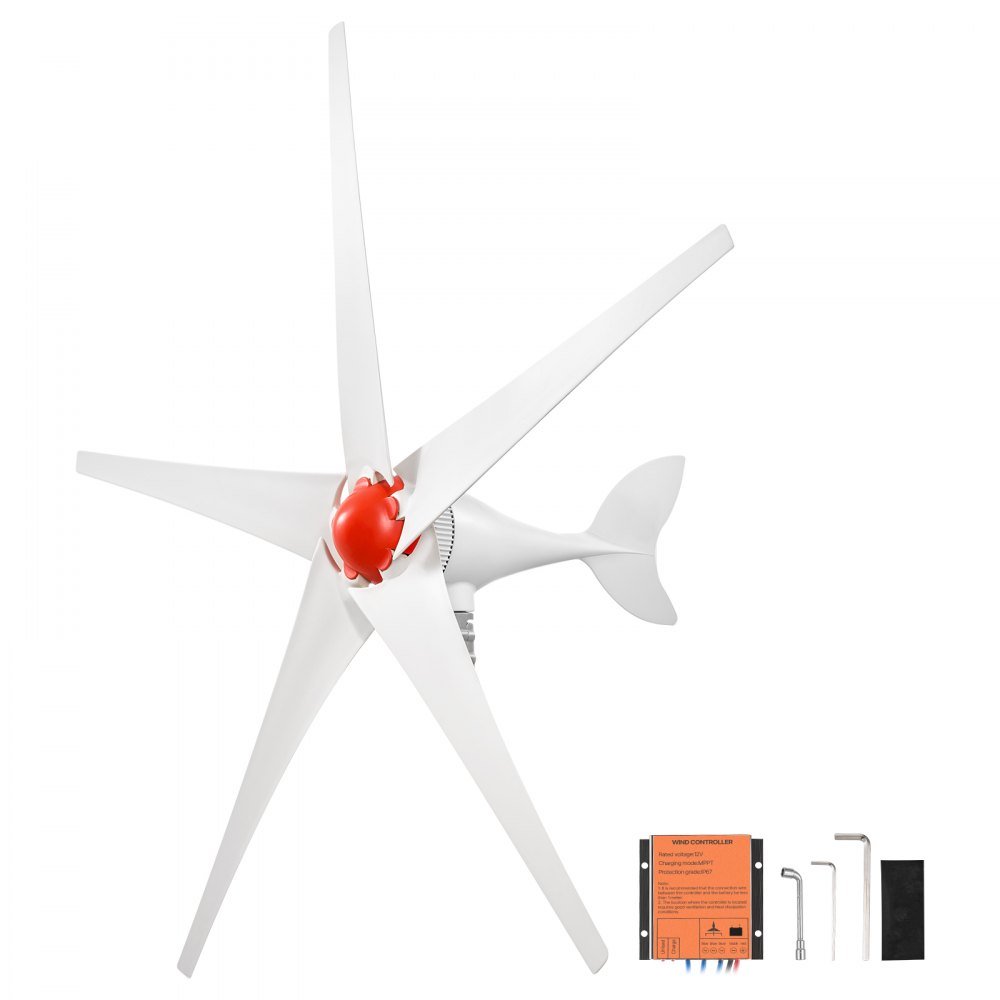
Five come from Pikasola and one from VEVOR; four are 400 W and all include a controller. Both brands are less known than the big power station makers, and warranty and wind-speed data are thin. Empty cells mean the listing does not publish that figure.
| Model | Rated power (W) | Voltage (V) | Blades | Start-up wind (m/s) | MPPT | Weight (kg) | Warranty (years) | WilderWatt score | Best for | |
|---|---|---|---|---|---|---|---|---|---|---|
| 800 | 12 | 5 | 2.5 | Yes | 8.5 | — | 7 | Highest rating | ||
| 400 | 12 | 3 | 2.5 | Yes | — | 1 | 7.5 | 12 V with MPPT | ||
| 400 | 24 | 3 | 2.5 | Yes | 8.4 | 1 | 7.5 | 24 V battery banks | ||
| 400 | 12 | 5 | 2.5 | — | 6.2 | — | 6 | Lightest | ||
| 400 | 12 | — | — | — | 8.3 | 1 | 6 | Wind plus solar | ||
| 200 | 12 | 5 | — | — | 11.3 | — | 5.5 | Vertical axis |
(affiliate link) · Data from the Amazon listing; offers may change.
- MPPT controllers are declared on the VEVOR and the two 3-blade Pikasolas. MPPT extracts more energy across changing wind speeds.
- 12 V or 24 V must match your battery bank. 24 V halves the current for the same power, which helps on long cable runs down a mast.
- Weight ranges from 6.2 kg (13.7 lb) for the 5-blade Pikasola to 11.3 kg (24.9 lb) for the vertical-axis model. The mast has to carry that load plus wind force.
What else do I need besides the turbine?
A mast, a battery bank, wiring, fusing and a way to stop the turbine safely. All six listings include a charge controller. You still need a battery, such as a 12V LiFePO4 battery, sized for the loads you want to run.
A turbine must never spin with no load connected, or it can overspeed. Read how to stop and brake a wind turbine safely before installing one.
Where should I go next?
- Are small wind turbines worth it?, with realistic output math.
- The best small wind turbines and the best turbines for off-grid cabins.
- Reviews: VEVOR 800W and Pikasola 400W, plus VEVOR 800W vs Pikasola 400W.
- Low output? See not charging in low wind.
- Have a stream instead? Read is micro hydro worth it?.
- Most sites get more from the sun: compare solar generator kits or build an off-grid system.
All about small wind turbines
Rankings and picks
- The 6 Best Small Wind Turbines of 2026 (With Realistic Output)The 6 best small wind turbines of 2026 for cabins, RVs and boats, compared on voltage, MPPT and weight, with realistic output for typical wind.
- The Best Small Wind Turbines for Off-Grid Cabins in 2026The best small wind turbines for off-grid cabins, with realistic daily output, 12V vs 24V advice, how wind pairs with solar in winter, and siting rules.
Comparisons
Guides and calculators
- Are Small Wind Turbines Worth It? Realistic Output, Costs and When They Make SenseAre small wind turbines worth it? The cube law, realistic output at 3-6 m/s, siting and permits, a comparison with solar and a calculator.
- Is Micro Hydro Worth It? Head, Flow, Water Rights and Realistic OutputIs micro hydro worth it? How head and flow set output, a worked example, US water rights and permits, and why we skip generic Amazon kits.
Troubleshooting and care
- How to Stop and Brake a Small Wind Turbine SafelyHow to stop a small wind turbine safely: brake switches, dump loads, storm prep and maintenance steps, plus the mistakes that cause runaway and damage.
- Wind Turbine Not Charging in Low Wind? Why and What to CheckWind turbine spinning but not charging in low wind? Learn the cube law, start-up vs charging speed, and check mast, brake, wiring and controller settings.
Frequently asked questions
How much power does a 400 W wind turbine really produce?
Far less than 400 W most of the time. If it reaches 400 W at 12 m/s, the cube law gives about 15 W at 4 m/s and about 29 W at 5 m/s, which is roughly 350-700 Wh a day in steady wind.
Can I mount a small wind turbine on my roof?
It is possible but rarely a good idea. Roofs create turbulence that cuts output and the vibration travels into the building. A tall, clear mast away from obstacles works much better.
Is wind or solar better for off-grid power?
Solar is better for most sites because it is predictable and needs no moving parts. Wind helps on very windy sites, in winter and at night, when solar output is low.
Do I need a permit for a small wind turbine?
Often, yes. Many towns and counties limit mast height, setbacks and noise. Check your local zoning rules and any HOA covenants before you buy.
What is the start-up wind speed?
It is the wind speed at which the rotor begins to turn. Four of the six turbines we list declare 2.5 m/s, but at that speed they produce almost nothing; useful output starts well above it.