
Pikasola 400W 12V 5-Blade Wind Turbine
400 W · 12 V. Review the available facts and what still needs checking before deciding whether it fits.
Not confirmed: Axis · Rated wind (m/s) · Rotor diameter (m) and 2 more.
Review, specifications and verdict
Editorial analysis based on published specifications; we have not physically tested this product.
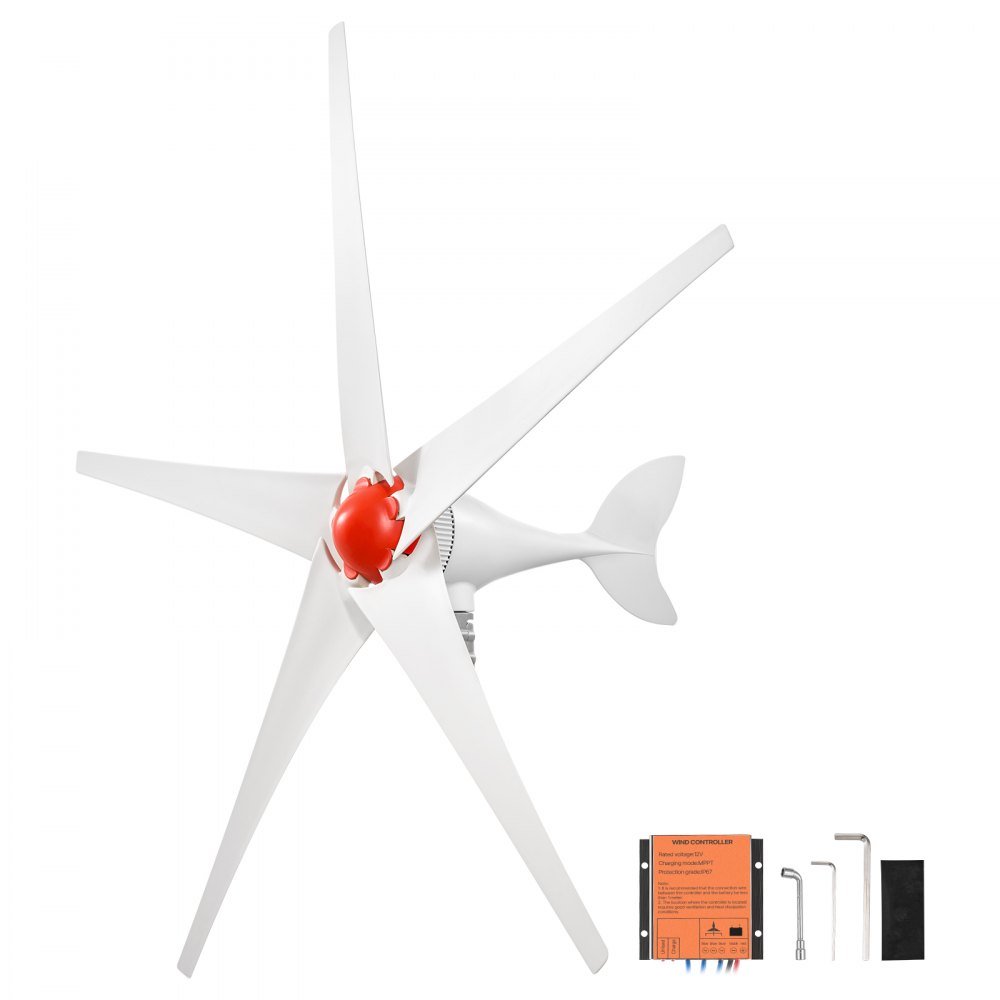
The Pikasola 400W 12V 5-Blade is a light wind turbine for 12V systems, with a controller included, a 2.5 m/s start-up speed and a 6.2 kg weight. Like every small turbine, its title figure is a high-wind rating, and the listing does not publish the wind speed behind it. We have not run it ourselves: specs come from the official Amazon listing, checked on September 26, 2026, and the physics is general.
The Pikasola 400W 5-blade is simple and light. At 6.2 kg, it is easier to lift onto a mast than the other turbines in our catalog with a published weight. It includes a charge controller, outputs 12V and starts turning at 2.5 m/s. What it lacks are the numbers that predict real output: rated wind speed, rotor diameter and a power curve. The listing also does not declare MPPT, which the Pikasola 3-blade 12V model does, and does not state a warranty. Use it as a small, steady top-up alongside solar on a windy site, not as a main power source.
Pros
- 6.2 kg, the lightest turbine with a published weight in our US catalog
- Controller included, 12V output
- Low 2.5 m/s start-up speed with 5 blades
Cons
- No MPPT, rated wind speed or rotor size declared
- No warranty term stated in this listing
- Best for
- Sailboats, vans and cabins on windy sites that already run a 12V solar bank
- Skip it if
- Sheltered yards, rooftops, or anyone expecting 400 W in normal wind
Specifications
| Rated power (W) | 400 |
|---|---|
| Voltage (V) | 12 |
| Blades | 5 |
| Start-up wind (m/s) | 2.5 |
| Controller included | Yes |
| Weight (kg) | 6.2 |
| Rated power (W) | 400 |
|---|---|
| Voltage (V) | 12 |
| Blades | 5 |
| Start-up wind (m/s) | 2.5 |
| Controller included | Yes |
| Weight (kg) | 6.2 |
How much power does it really make?
In a typical 4–5 m/s breeze, roughly 15–30 W. Wind power scales with the cube of wind speed, so a third of the rated wind speed gives about one twenty-seventh of the rated power.
The rated wind speed is not published. Small turbines are commonly rated at about 11–13 m/s (25–29 mph), so we assume 12 m/s. Output ≈ 400 × (v ÷ 12)³:
| Wind speed | Math | Approximate output |
|---|---|---|
| 3 m/s (6.7 mph) | 400 × (3 ÷ 12)³ | 6 W |
| 4 m/s (8.9 mph) | 400 × (4 ÷ 12)³ | 15 W |
| 5 m/s (11.2 mph) | 400 × (5 ÷ 12)³ | 29 W |
| 6 m/s (13.4 mph) | 400 × (6 ÷ 12)³ | 50 W |
| 8 m/s (17.9 mph) | 400 × (8 ÷ 12)³ | 119 W |
| 12 m/s (26.8 mph) | rated | 400 W |
These are ceilings. They assume clean airflow and no losses in the controller or wiring.
How much energy per day?
At a steady 4 m/s, about 0.36 kWh at most: 15 W × 24 hours. At a steady 5 m/s, about 0.69 kWh. Real wind varies: calm hours below 2.5 m/s give nothing, and gusty, turbulent air around buildings gives less than the table.
One 100 W solar panel makes about 375 Wh on a 5-peak-sun-hour summer day (100 × 0.75 × 5). So in summer, a single small panel roughly matches this turbine in a 4 m/s breeze. The turbine earns its place at night, in winter and during stormy spells. Put in your own average wind below.
Estimated average output: 0 W · 0 Wh/day · 0 kWh/year
Formula: average power ≈ rated power × (average wind ÷ rated wind)³ × 1.9, capped at rated power. The 1.9 factor accounts for wind variability (Rayleigh distribution). It is an optimistic estimate: obstacles, mast height and turbulence reduce it.
Where does it work best?
On an open, windy site with the rotor on a tall, clear mast. Roofs, trees and nearby buildings create turbulence that cuts output and adds vibration.
Good fits are sailboats, exposed coastal homes, ridge-top cabins and open farmland. A short pole in a suburban backyard will likely disappoint. Check local zoning, HOA rules and any height or noise limits before installing a mast.
How does it connect?
Through the included controller to a 12V battery bank. At a full 400 W, charge current reaches 400 ÷ 12.8 = 31 A, so size cables and fuses for that peak.
The listing does not say the controller is MPPT or that it supports LiFePO4 charging. Check both in the manual before pairing it with a lithium battery such as the GOKWH 12V 100Ah. Plan how to stop the rotor in storms; see how to stop and brake a wind turbine safely.
Should you pick 12V or 24V?
Match the turbine to your battery bank. This model is 12V. For the same power, a 24V system carries half the current, which means thinner cables and lower losses over a long mast run.
If your bank is 24V, the Pikasola 400W 24V 3-Blade suits it, with an MPPT controller, 8.4 kg and a 1-year warranty. For small RVs and boats, 12V is the norm.
What is missing from the listing?
MPPT, rated wind speed, rotor diameter, a power curve and a warranty term. The first four decide real output; the last decides what happens if it fails.
Our review method scores turbines on what they declare. An included controller and a low start-up speed count; an undeclared MPPT and warranty do not.
6/10 · WilderWatt scoreHow does it compare with the other Pikasola models and the VEVOR 800W?
The 5-blade is the lightest; the 3-blade models add MPPT and a 1-year warranty; the VEVOR adds a higher rating.
| Model | Rated power (W) | Voltage (V) | Blades | Start-up wind (m/s) | MPPT | Weight (kg) | Warranty (years) | WilderWatt score | |
|---|---|---|---|---|---|---|---|---|---|
| 400 | 12 | 5 | 2.5 | — | 6.2 | — | 6 | ||
| 400 | 12 | 3 | 2.5 | Yes | — | 1 | 7.5 | ||
| 800 | 12 | 5 | 2.5 | Yes | 8.5 | — | 7 |
(affiliate link) · Data from the Amazon listing; offers may change.
- Pikasola 400W 12V 3-Blade: MPPT controller, 2.5 m/s start-up and a 1-year warranty. The catch is no published weight.
- VEVOR 800W 12V: 5 blades, MPPT controller and 8.5 kg. The catch is no stated warranty. Read our VEVOR 800W review or the head-to-head VEVOR 800W vs Pikasola 400W.
Who should buy the Pikasola 400W 5-blade?
Owners of 12V systems on windy sites who want a light, simple add-on.
Buy it if you:
- Sail or live somewhere with strong, regular wind.
- Want charging at night and in winter to support solar.
- Need a turbine light enough for a simple pole mast.
Skip it if you:
- Want MPPT or a stated warranty; choose the 3-blade 12V model.
- Live in a sheltered area; panels will do more. See portable solar panels.
For the bigger picture, read are small wind turbines worth it?
Frequently asked questions
How much power does the Pikasola 400W make in normal wind?
Much less than 400 W. Assuming it is rated at about 12 m/s, output is around 15 W at 4 m/s and 29 W at 5 m/s, because power falls with the cube of wind speed.
Does the Pikasola 400W 5-blade include a charge controller?
Yes, a charge controller is included. The listing does not state that it is MPPT, unlike the Pikasola 3-blade 12V model.
Is the Pikasola 400W 12V or 24V?
This 5-blade model is 12V. Pikasola also sells a 24V 3-blade version for 24V battery banks.
Can the Pikasola 400W charge a lithium battery?
It charges a 12V bank through its controller. Check that the controller supports a LiFePO4 charge profile before connecting it to a lithium battery.
Is a 400W wind turbine enough for an RV or boat?
As a complement to solar on a windy site, yes. On its own, in a 4 m/s breeze, it gives roughly 0.36 kWh per day at most, about what one 100 W panel makes on a summer day.