
EcoFlow DELTA Pro 3
4,096 Wh · 4,000 W. Review the available facts and what still needs checking before deciding whether it fits.
Not confirmed: Cycles · AC outlets · USB-C ports and 2 more.
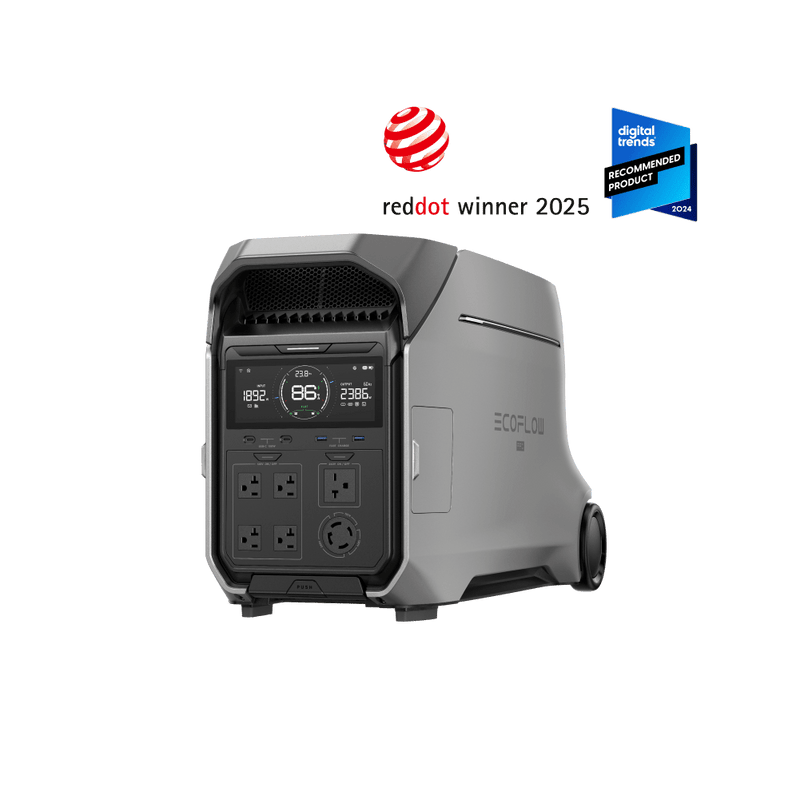
Review, specifications and verdict
Editorial analysis based on published specifications; we have not physically tested this product.
The EcoFlow DELTA Pro 3 is a 4,096 Wh LiFePO4 station with 4,000 W of output, a declared 10 ms UPS switchover and expansion up to 48,000 Wh. On paper, it is the biggest battery and the highest output in our US station catalog. We have not run it ourselves: the figures come from the official Amazon listing, checked on September 26, 2026, and the math is ours.
The DELTA Pro 3 sits a step above the 3 kWh class. It stores 4,096 Wh, outputs 4,000 W and lists 6,000 W in X-Boost mode, which our spec table files under surge. The 10 ms switchover protects computers during a grid failure. Expansion to 48 kWh is the headline: no other station in our US catalog declares more. EcoFlow backs it with a 5-year warranty. The costs are practical. At 52.2 kg, it needs a hand truck and a permanent spot. The US listing also leaves out solar input and cycle life. For most households, the 3 kWh stations cover a day of essentials with less weight.
Pros
- 4,096 Wh LiFePO4 and 4,000 W, the most in our US catalog
- Declared 10 ms UPS switchover
- Expandable to 48 kWh, with a 5-year warranty
Cons
- 52.2 kg (about 115 lb), the heaviest station we track
- No published solar input or cycle rating in the US listing
- Best for
- Whole-home essentials backup that may grow into a multi-day system
- Skip it if
- Anyone who needs to move the unit, or who only needs a day of essentials
Specifications
| Capacity (Wh) | 4,096 |
|---|---|
| AC output (W) | 4,000 |
| Surge (W) | 6,000 |
| Chemistry | LiFePO4 |
| Weight (kg) | 52.2 |
| UPS (ms) | 10 |
| Expandable to (Wh) | 48,000 |
| Warranty (years) | 5 |
| Capacity (Wh) | 4,096 |
|---|---|
| AC output (W) | 4,000 |
| Surge (W) | 6,000 |
| Chemistry | LiFePO4 |
| Weight (kg) | 52.2 |
| UPS (ms) | 10 |
| Expandable to (Wh) | 48,000 |
| Warranty (years) | 5 |
How long will the DELTA Pro 3 keep your home running?
Plan on about 3,482 usable watt-hours. We apply a 0.85 factor for inverter and conversion losses: 4,096 × 0.85 = 3,482 Wh.
| Load (typical draw) | Math | Approximate runtime |
|---|---|---|
| Full-size fridge, 60 W average | 3,482 ÷ 60 | 58 hours |
| Fridge + router + LED lights, 95 W | 3,482 ÷ 95 | 36.6 hours |
| Essentials + CPAP, 135 W | 3,482 ÷ 135 | 25.8 hours |
| Window AC unit, 500 W | 3,482 ÷ 500 | 7 hours |
| Space heater, 1,500 W | 3,482 ÷ 1,500 | 2.3 hours |
The practical reading: a day and a half of essentials, or an afternoon of cooling. Use the solar calculator with your own appliance list.
What can 4,000 W run?
Any single standard 120 V appliance, and several at once. At 120 V, 4,000 W equals about 33 A in total. A microwave, a coffee maker and a fridge together stay well within that.
EcoFlow lists 6,000 W with X-Boost. X-Boost lowers voltage to run resistive loads such as heaters; it is not a guaranteed motor-start surge rating. For well pumps and compressors, check starting watts against the manual.
Our spec data does not confirm 240V output. If you need 240V for a pump, dryer or range, confirm it with EcoFlow first. Any link to your home panel needs a transfer switch or inlet installed by a licensed electrician.
How much does the 48 kWh expansion really give you?
Fully expanded, up to 40,800 usable watt-hours: 48,000 × 0.85. On a 95 W essentials load, that is 40,800 ÷ 95 = 429 hours, or almost 18 days with no recharging.
Few households need that much. The more realistic use is one or two extra batteries to bridge a multi-day storm outage, or storing daytime solar for the night. The extra batteries are sold separately, so treat the 48 kWh figure as a ceiling, not the box you receive.
How fast does it recharge from solar?
The US listing does not publish a maximum solar input, so we cannot state a charge time. Here is how many panel watts a full refill takes, using capacity ÷ (panel watts × 0.75):
- 800 W of panels: 4,096 ÷ 600 = 6.8 peak sun hours.
- 1,200 W of panels: 4,096 ÷ 900 = 4.6 peak sun hours.
- 1,600 W of panels: 4,096 ÷ 1,200 = 3.4 peak sun hours.
That is rooftop-array territory, not a pair of folding panels. Check the input limits in the manual before buying panels. For US sun hours, see how many solar watts you need.
Does it switch over fast enough for computers?
Yes, on paper: EcoFlow declares 10 ms. That matches the DELTA 3 Ultra Plus and beats the 20 ms of the Jackery HomePower 3000.
Keep the station on grid power with your sensitive devices plugged into it. When the grid drops, the switchover happens without a reboot in most cases.
How portable is it?
At 52.2 kg (115 lb), it is not portable in any everyday sense. Energy density is 4,096 ÷ 52.2 = 78.5 Wh/kg, below the 90 Wh/kg bar in our review method.
Pick a garage, basement or utility room and leave it there. Moving it between floors is a two-person job.
8/10 · WilderWatt scoreHow does it compare with the DELTA 3 Ultra Plus and Anker SOLIX F3000?
The DELTA Pro 3 wins on capacity, output and expansion; the other two are lighter.
| Model | Capacity (Wh) | AC output (W) | Weight (kg) | UPS (ms) | Max solar input (W) | Expandable to (Wh) | WilderWatt score | |
|---|---|---|---|---|---|---|---|---|
| 4,096 | 4,000 | 52.2 | 10 | — | 48,000 | 8 | ||
| 3,072 | 3,600 | 33.6 | 10 | — | 11,000 | 9 | ||
| 3,072 | 3,600 | 41.5 | — | 2,400 | 24,000 | 9 |
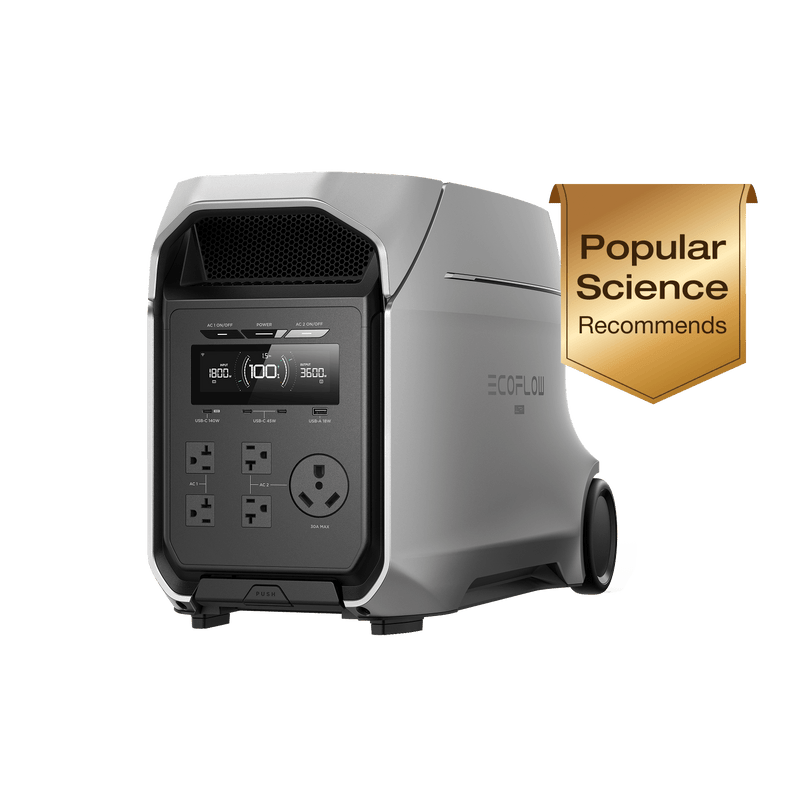
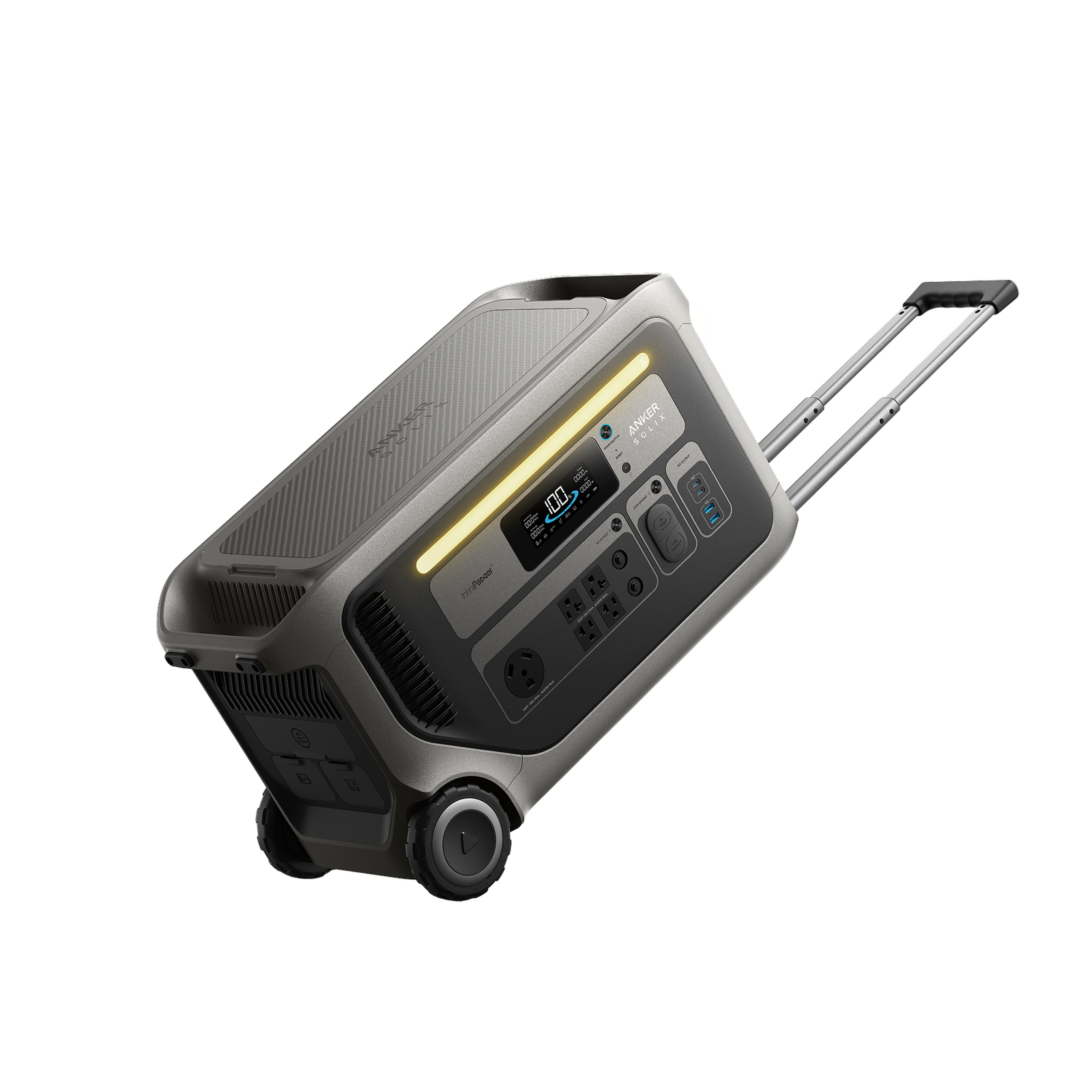
(affiliate link) · Data from the Amazon listing; offers may change.
- EcoFlow DELTA 3 Ultra Plus: 3,072 Wh, 3,600 W, 7,200 W surge, the same 10 ms UPS and 33.6 kg. The catch is expansion capped at 11 kWh. Full breakdown in DELTA Pro 3 vs DELTA 3 Ultra Plus.
- Anker SOLIX F3000: 3,072 Wh, 3,600 W and a declared 2,400 W solar input, with expansion to 24 kWh. The catch is no declared UPS switchover. Read our Anker SOLIX F3000 review.
Who is the DELTA Pro 3 for?
It is for households building a long-duration backup system around one station.
Buy it if you:
- Want to run several appliances at once in an outage.
- Expect to add batteries for multi-day autonomy.
- Have a fixed spot for a 52 kg unit.
Skip it if you:
- Need a day of essentials; a 3 kWh unit covers that with less weight. See our home backup picks.
- Want published solar input figures before buying.
- Plan to take it camping.
Frequently asked questions
How long can the EcoFlow DELTA Pro 3 run a house?
On essentials of about 95 W (fridge, router, LED lights), roughly 36.6 hours: 4,096 Wh × 0.85 ÷ 95 W. Heating, cooling or cooking cut that to hours.
How far can the DELTA Pro 3 be expanded?
EcoFlow states the 4,096 Wh battery is expandable to 48 kWh with extra batteries, sold separately.
Does the EcoFlow DELTA Pro 3 work as a UPS?
Yes. EcoFlow declares a 10 ms switchover, fast enough for most desktop PCs and network equipment.
How heavy is the EcoFlow DELTA Pro 3?
It weighs 52.2 kg, about 115 lb. It is the heaviest station in our US catalog, so plan a permanent spot for it.
Can the DELTA Pro 3 power a 240V appliance?
Our spec data does not confirm 240V output. Check with EcoFlow before buying for a 240V well pump or dryer, and use a licensed electrician for any panel connection.