
Jackery SolarSaga 200W
200 W. Review the available facts and what still needs checking before deciding whether it fits.
Not confirmed: Voc (V).
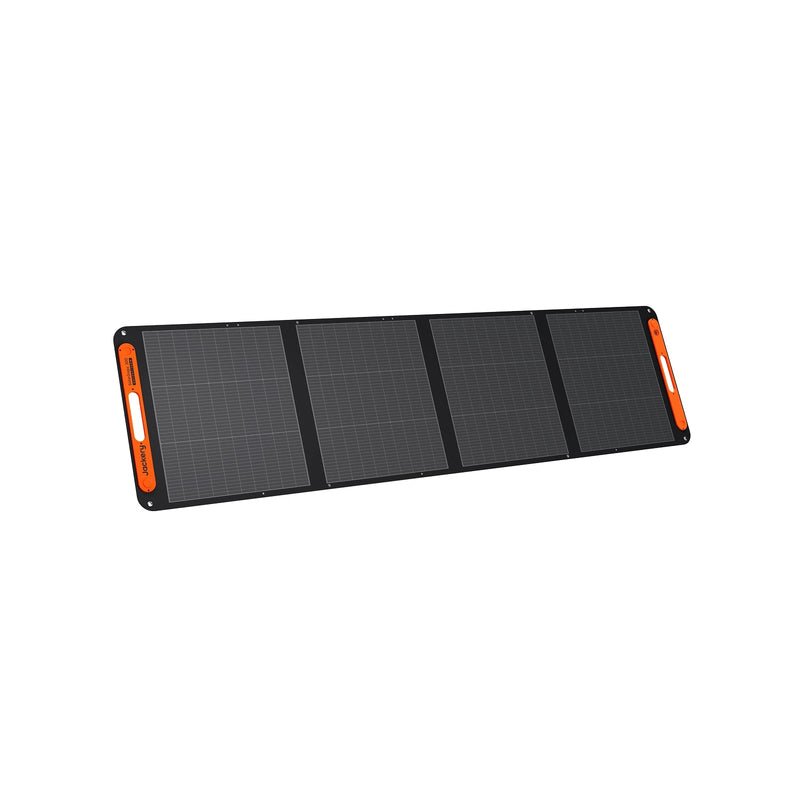
Review, specifications and verdict
Editorial analysis based on published specifications; we have not physically tested this product.
The Jackery SolarSaga 200W is a bifacial folding panel with 26.7% efficiency, IP68 sealing and a 5-year warranty, at 6.5 kg. On paper, it is the best-specified 200 W panel in our US catalog. We have not used it ourselves: the figures come from the official Amazon listing, checked on September 26, 2026, and the math is ours.
The SolarSaga 200W leads its class on paper. Its 26.7% efficiency is the highest in our US panel catalog, and the bifacial cells can pick up reflected light on the back. IP68 means it tolerates dust and water better than any other 200 W panel we track, and the 5-year warranty is more than double most rivals. It also has USB-C and USB-A ports for charging phones directly. The trade-offs are the DC8020 connector, which pairs natively with Jackery stations, and a weight of 6.5 kg. The listing does not publish an open-circuit voltage.
Pros
- 26.7% efficiency, the highest among our US panels
- Bifacial cells and IP68 water and dust rating
- 5-year warranty, the longest among our US 200 W panels
Cons
- DC8020 connector suits Jackery stations; others need an adapter
- 6.5 kg, slightly heavier than the Renogy and BougeRV 200 W panels
- Best for
- Jackery station owners and anyone camping in wet or dusty conditions
- Skip it if
- Buyers with MC4 or XT60 stations who do not want extra adapters
Specifications
| Power (W) | 200 |
|---|---|
| Efficiency (%) | 26.7 |
| Weight (kg) | 6.5 |
| Bifacial | Yes |
| IP rating | IP68 |
| Connector | DC8020 |
| USB output | Yes |
| Warranty (years) | 5 |
| Power (W) | 200 |
|---|---|
| Efficiency (%) | 26.7 |
| Weight (kg) | 6.5 |
| Bifacial | Yes |
| IP rating | IP68 |
| Connector | DC8020 |
| USB output | Yes |
| Warranty (years) | 5 |
How much power will you actually get?
Plan on about 150 W in good sun, not 200 W. Heat, angle and haze typically cut portable panels to 70–80% of their rating. We use 0.75: 200 × 0.75 = 150 W.
| Conditions | Peak sun hours | Math | Daily energy |
|---|---|---|---|
| Sunny summer day, Southwest | 6 | 150 × 6 | 900 Wh |
| Typical summer day, most of the US | 5 | 150 × 5 | 750 Wh |
| Spring or fall day | 4 | 150 × 4 | 600 Wh |
| Northern winter day | 2.5 | 150 × 2.5 | 375 Wh |
These sun-hour values are approximate. See how many solar watts you need for a regional breakdown.
Does the bifacial design help?
Yes, a little, and only with a bright surface behind or below it. Bifacial cells collect light that reflects onto the back of the panel. Over sand, snow, a white tarp or light concrete, that adds output. Over dark grass or soil, the gain is small.
Treat any bifacial gain as a bonus, not part of your sizing. Our calculations above use the front-side rating only.
How long does it take to charge a power station?
Divide station capacity by 150 W to get peak sun hours. The formula is capacity ÷ (panel watts × 0.75).
- Grecell H1200 (672 Wh): 672 ÷ 150 = 4.5 peak sun hours, about one summer day.
- EcoFlow DELTA 3 (1,024 Wh): 1,024 ÷ 150 = 6.8 peak sun hours.
- Jackery Explorer 2000 v2 (2,042 Wh): 2,042 ÷ 150 = 13.6 peak sun hours with one panel; 6.8 with two.
Jackery sells the Explorer 2000 v2 in a kit with two 200 W panels, compared in our best solar generators. Read our Jackery Explorer 2000 v2 review for the station side.
Will it plug into your station?
Directly into Jackery stations; with an adapter for most others. The panel outputs through a DC8020 port. Other brands use XT60, Anderson, DC7909 or MC4 inputs.
If you own a non-Jackery station, buy an adapter that matches its solar input and check the voltage window in the manual. The listing does not publish the panel’s Voc, so confirm it from the label before wiring two panels in series. A loose or wrong adapter is a common reason a power station does not charge from solar.
How tough is it?
IP68 is the strongest weather rating among the portable panels we track. It means dust-tight and rated against immersion under the manufacturer’s test conditions.
In practice, a sudden rain shower on the campsite is not a problem. The connectors and cable ends are still the weak points: keep them dry and off the ground. The 5-year warranty backs that durability claim.
How portable is it?
At 6.5 kg (about 14.3 lb), it is a car-camping panel. That is 3.25 kg per 100 W, or about 30.8 W per kg.
The Renogy EFLEX 200W and BougeRV 200W weigh 6.3 kg each, so the Jackery is only 0.2 kg heavier. For backpacking, a 100 W panel under 3 kg makes more sense; see our best solar panels for camping.
9.5/10 · WilderWatt scoreHow does it compare with the Renogy EFLEX 200W and BougeRV 200W?
The Jackery leads on efficiency, sealing and warranty; the others weigh slightly less.
| Model | Power (W) | Efficiency (%) | Weight (kg) | IP rating | Connector | Warranty (years) | WilderWatt score | |
|---|---|---|---|---|---|---|---|---|
| 200 | 26.7 | 6.5 | IP68 | DC8020 | 5 | 9.5 | ||
| 200 | 25 | 6.3 | — | MC4 | 2 | 8 | ||
| 200 | 25 | 6.3 | IP65 | XT60, DC7909 | — | 8 |

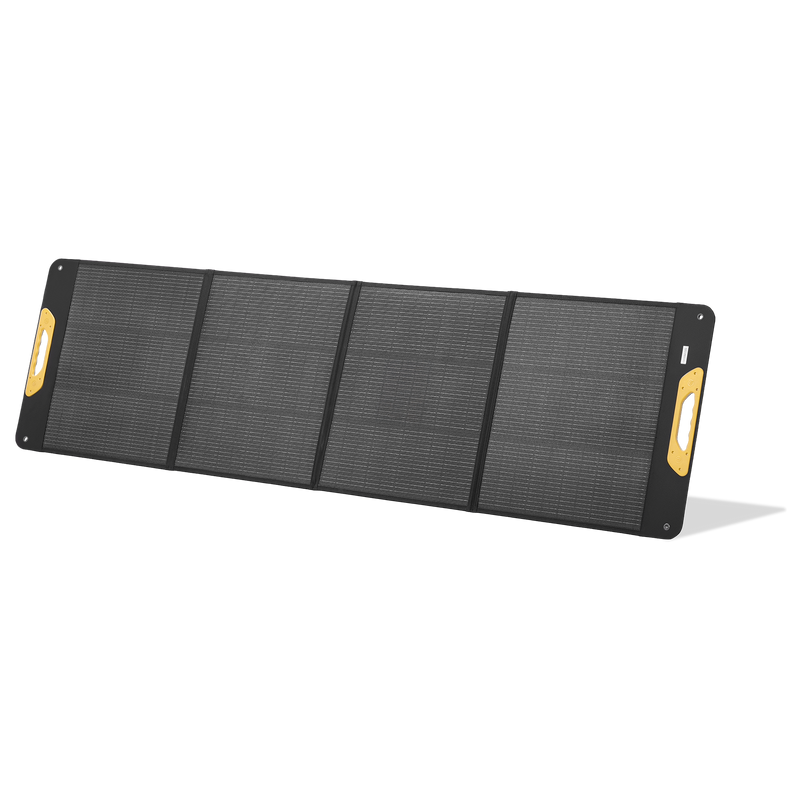
(affiliate link) · Data from the Amazon listing; offers may change.
- Renogy EFLEX 200W: 25% efficiency, 6.3 kg, USB outputs and a 2-year warranty. The catch is MC4-only output and no published IP rating. Read our Renogy EFLEX 200W review.
- BougeRV 200W: 25% efficiency, 6.3 kg, IP65, with XT60 and DC7909 connectors included. The catch is that the listing does not state a warranty term.
Who should buy the SolarSaga 200W?
Jackery owners first, and anyone who wants the most weatherproof 200 W panel.
Buy it if you:
- Own a Jackery Explorer or HomePower station.
- Camp where rain, dust or sand are common.
- Value a 5-year warranty.
Skip it if you:
- Run an MC4-based RV system and want plug-and-play.
- Need the lightest possible 200 W panel.
For other options, browse the best portable solar panels.
Frequently asked questions
How much power does the Jackery SolarSaga 200W really produce?
Plan on about 150 W in good sun, since portable panels usually deliver 70–80% of their rating. Over 5 peak sun hours, that is roughly 750 Wh.
Does the bifacial design add much power?
It can add some output when light reflects onto the back, for example over sand, snow or a light-colored surface. Over dark grass the gain is small. Jackery’s rating is the front-side figure.
Is the SolarSaga 200W waterproof?
Jackery lists an IP68 rating for water and dust resistance, the highest rating among the 200 W panels in our US catalog.
Will the SolarSaga 200W work with non-Jackery power stations?
It uses a DC8020 output, so you need an adapter that matches your station’s solar input. Check your station’s voltage range as well, since the listing does not publish Voc.
How long does the SolarSaga 200W take to charge a Jackery Explorer 2000 v2?
About 13.6 peak sun hours with one panel: 2,042 ÷ (200 × 0.75). Two panels cut that to about 6.8 peak sun hours.