
GOKWH 12V 100Ah Group24
12 V · 100 Ah · 1,280 Wh. Review the available facts and what still needs checking before deciding whether it fits.
Not confirmed: Self-heating · IP rating · Warranty (years).
Review, specifications and verdict
Editorial analysis based on published specifications; we have not physically tested this product.
The GOKWH 12V 100Ah Group 24 is a 1,280 Wh LiFePO4 battery with a 100 A BMS, 4,000 declared cycles, Bluetooth monitoring and low-temperature protection, at 10.9 kg. On paper, it covers everything a first lithium battery for an RV, a small boat or a solar shed needs. We have not used it ourselves: the specs come from the official Amazon listing, checked on September 26, 2026, and the math is ours. GOKWH is a lesser-known brand, so check the manual and support contact before you rely on it.
The GOKWH 100Ah hits the core specs of a modern 12V LiFePO4 battery. It stores 1,280 Wh, and its 100 A BMS matches its capacity, so it can deliver its full rating continuously. The 4,000-cycle rating means years of daily use, and Bluetooth lets you check charge level and cell status from a phone. The Group 24 case size fits common battery trays. At 10.9 kg (about 24 lb), it weighs a fraction of a lead-acid battery of similar usable capacity. The gaps are the warranty, which the listing does not state, and the lack of self-heating for cold-weather charging.
Pros
- 1,280 Wh with a 100 A BMS, about 1,280 W continuous
- 4,000 declared cycles and Bluetooth monitoring
- Low-temperature protection and 4S4P expansion
Cons
- No warranty term, IP rating or self-heating stated in the listing
- Lesser-known brand; after-sales support is harder to judge
- Best for
- RV house batteries, kayaks and small boats, and small off-grid solar setups
- Skip it if
- Winter charging below freezing, or buyers who need a stated warranty
Specifications
| Voltage (V) | 12 |
|---|---|
| Capacity (Ah) | 100 |
| Capacity (Wh) | 1,280 |
| Chemistry | LiFePO4 |
| Cycles | 4,000 |
| BMS (A) | 100 |
| Bluetooth | Yes |
| Low-temp protection | Yes |
| Weight (kg) | 10.9 |
| Max in parallel | 4 |
| Max in series | 4 |
| Voltage (V) | 12 |
|---|---|
| Capacity (Ah) | 100 |
| Capacity (Wh) | 1,280 |
| Chemistry | LiFePO4 |
| Cycles | 4,000 |
| BMS (A) | 100 |
| Bluetooth | Yes |
| Low-temp protection | Yes |
| Weight (kg) | 10.9 |
| Max in parallel | 4 |
| Max in series | 4 |
How much energy does it really hold?
About 1,280 Wh, and you can use most of it. LiFePO4 runs at 12.8 V nominal, so 12.8 × 100 Ah = 1,280 Wh. Unlike lead-acid, you can discharge it deeply without shortening its life much.
We keep a 10% reserve for DC loads, which gives 1,280 × 0.9 = 1,152 Wh. Through an inverter, we use 0.85 for losses: 1,280 × 0.85 = 1,088 Wh of AC.
| Load (typical draw) | Math | Approximate runtime |
|---|---|---|
| 12V compressor fridge, 45 W | 1,152 ÷ 45 | 25.6 hours |
| LED lights + fan + phone charging, 25 W | 1,152 ÷ 25 | 46 hours |
| Trolling motor at 30 A | 90 Ah ÷ 30 A | 3 hours |
| Trolling motor at 50 A | 90 Ah ÷ 50 A | 1.8 hours |
| Coffee maker via inverter, 1,000 W | 1,088 ÷ 1,000 | about 65 minutes |
The draws are typical figures. Size your own setup with the battery calculator.
What does the 100 A BMS mean in practice?
It caps continuous output at about 1,280 W: 100 A × 12.8 V. The BMS (battery management system) cuts power above that to protect the cells.
That rules out a 2,000 W inverter at full load on a single battery. A 1,000 W inverter is a comfortable match. For bigger AC loads, wire two batteries in parallel to double the available current. If your battery shuts off under load, see why a LiFePO4 BMS cuts power.
How does it handle cold weather?
The listing declares low-temperature protection, but no self-heating. Our spec data does not include the exact cutoff temperature, so check it in the manual.
The general rule for LiFePO4 is simple: do not charge below 32 °F (0 °C) unless the battery heats itself. Discharging in the cold is fine within the maker’s limits. In a winter RV, keep the battery inside the heated space. Our guide to cold-weather charging explains the options.
Can you charge it from a vehicle alternator?
Yes, but through a DC-DC charger, not a direct connection. A lithium battery can pull more current than an alternator is designed to supply continuously, and the charging voltage needs control.
A DC-DC charger limits the current and delivers a proper LiFePO4 charge profile. We explain sizing in charging a LiFePO4 battery from an alternator.
How far can you expand it?
GOKWH states up to 4 batteries in series and 4 in parallel (4S4P).
- Series adds voltage: 4 × 12.8 V = 51.2 V, for 48V inverters and trolling motors.
- Parallel adds capacity: 4 × 100 Ah = 400 Ah at 12.8 V, or 5,120 Wh.
- Full 4S4P: 16 batteries, 16 × 1,280 = 20,480 Wh.
Use identical batteries at the same charge level when you combine them.
How long will it last?
4,000 declared cycles is about 11 years at one full cycle per day (4,000 ÷ 365). Most RV and boat owners cycle far less often.
Energy density is 1,280 ÷ 10.9 = 117.4 Wh/kg, just short of the 120 Wh/kg mark in our review method.
8/10 · WilderWatt scoreHow does it compare with the GOKWH Marine 100Ah and 320Ah?
The Marine 100Ah is the same battery on paper; the 320Ah triples the energy for more than twice the weight.
| Model | Capacity (Ah) | Capacity (Wh) | BMS (A) | Cycles | Weight (kg) | Bluetooth | WilderWatt score | |
|---|---|---|---|---|---|---|---|---|
| 100 | 1,280 | 100 | 4,000 | 10.9 | Yes | 8 | ||
| 100 | 1,280 | 100 | 4,000 | 10.9 | Yes | 8 | ||
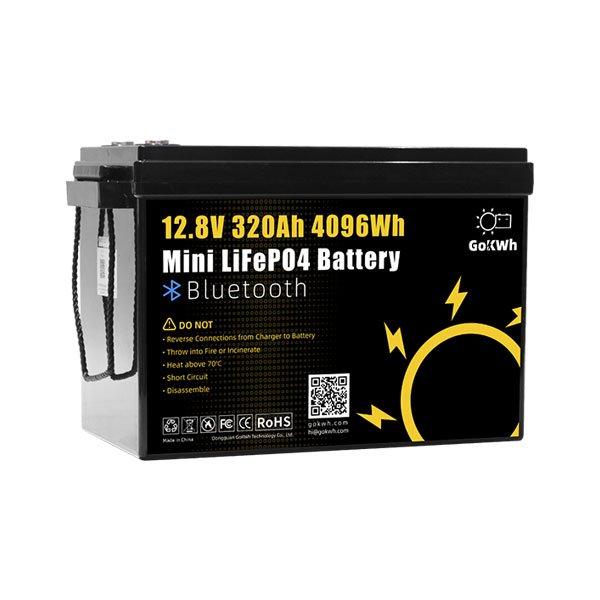
| 320 | 4,096 | 200 | — | 24.9 | Yes | 7.5 |
(affiliate link) · Data from the Amazon listing; offers may change.
- GOKWH 12V 100Ah Marine Bluetooth: identical declared specs: 1,280 Wh, 100 A BMS, 4,000 cycles, 10.9 kg. It is marketed for trolling motors; pick whichever listing is available. See our best batteries for trolling motors.
- GOKWH 12V 320Ah Bluetooth: 4,096 Wh and a 200 A BMS at 24.9 kg. The catch is that its listing does not publish a cycle rating. Full comparison in 12V 100Ah vs 320Ah.
Who should buy the GOKWH 12V 100Ah?
Buyers who want a light, full-featured 100Ah battery and can live without a stated warranty.
Buy it if you:
- Replace a lead-acid house battery in an RV or van.
- Run a trolling motor or small boat electronics.
- Start a small solar system you may expand later.
Skip it if you:
- Charge outdoors in freezing weather without a heated space.
- Want a known brand with a published warranty.
For other options, see the best LiFePO4 batteries.
Frequently asked questions
How many watt-hours is a 12V 100Ah LiFePO4 battery?
About 1,280 Wh. LiFePO4 batteries sit at 12.8 V nominal, so 12.8 V × 100 Ah = 1,280 Wh.
How much power can the GOKWH 100Ah deliver?
Its 100 A BMS allows about 1,280 W continuous at 12.8 V. Through an inverter, plan on roughly 1,000–1,100 W of AC after losses.
How long will the GOKWH 100Ah run a trolling motor?
At a steady 30 A draw, about 3 hours: 100 Ah × 0.9 ÷ 30 A. At 50 A, about 1.8 hours.
Can I charge the GOKWH 100Ah below freezing?
The listing declares low-temperature protection but not self-heating. As a rule, do not charge LiFePO4 below 32 °F (0 °C); check the exact cutoff in the manual.
Can I connect several GOKWH 100Ah batteries together?
GOKWH states up to 4 in series and 4 in parallel (4S4P). That reaches 51.2 V or 400 Ah, and up to 20,480 Wh with 16 batteries.
What warranty does the GOKWH 12V 100Ah have?
The listing we reviewed does not state a warranty term. Ask the seller before buying and keep your proof of purchase.